



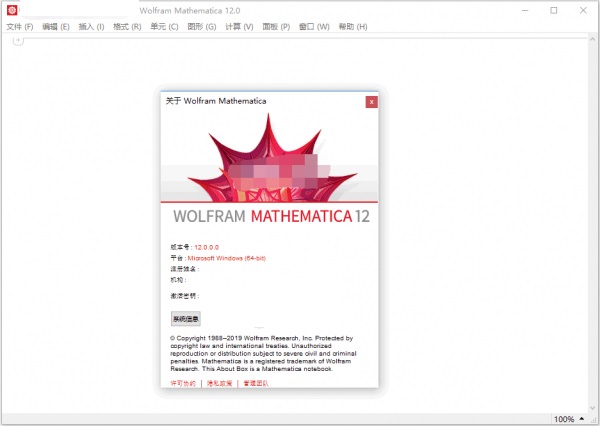
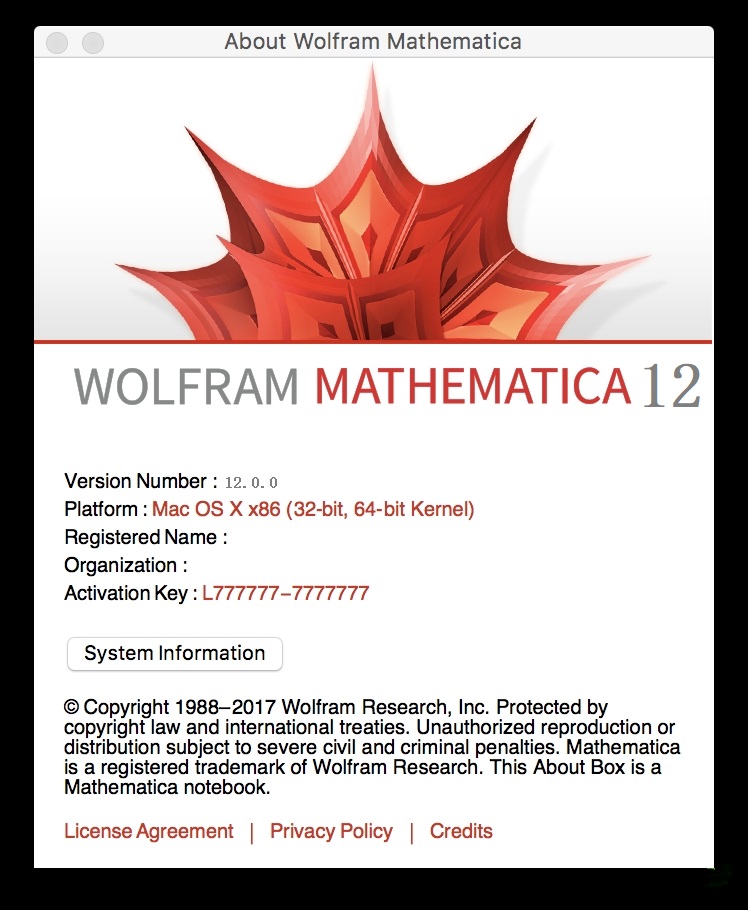
Introduction to Mathematica 12 software
Mathematica is a scientific computing software that combines numerical and symbolic computing engines, graphics systems, programming languages, text systems, and advanced connections with other applications. Many functions are world-leading in the corresponding field, and it is also one of the most widely used mathematics software. The release of Mathematica marked the beginning of modern technological computing. Mathematica is the most powerful general-purpose computing system in the world. Since its release in 1988, it has had a profound impact on how computers are used in technology and other fields.
Mathematica 12 software features
1.Support symbolic order derivatives
2. High-resolution geographic elevation data
3.Expanded support for computational photography and computational microscopy
4.130+ new functions spanning a wide range of application areas
5. New responsive design applied to all documents and online examples
6.AutoCopy perfectly distributes independent editable notebooks in the cloud
7.ImageGraphics is used to find vector graphics that are similar to bitmaps
8. Automated Wolfram Language scripts also available on Windows
9. Directly apply algorithms on two-dimensional and three-dimensional images (use "*" or "-", etc.)
10.NetModel for accessing a growing repository of trained and untrained neural networks
11. Create WolframScript .wls files using a notebook-based script editor
12. New robust spatial statistics, including WinsorizedMean and SpatialMedian
13. Seamless integration of external services for web page query, web page image query and text translation
14. Extensive PersistentValue system for storing inter-session values locally, in the cloud, etc.
15. Space-filling and fractal area builders such as HilbertCurve and SierpinskiMesh
16.FeatureSpacePlot is used for spatial visualization of data, images and text based on machine learning
17. Use AudioCapture to record audio directly in your notebook and process and analyze it directly
18.20 new neural network layer types, and seamless support for recurrent neural networks and variable-length sequences
19.GeoBubbleChart and extended support for functions such as Callout and ScalingFunctions
20. New machine learning functions, including SequencePredict, ActiveClassification and ActivePrediction
Mathematica 12 software highlights
Instant real-time data
Mathematica has access to the extensive Wolfram knowledge base, which includes the latest real-time data in thousands of fields
This code makes sense
With its intuitive English-like function names and consistent design, wolfram language is easy to read, write and learn
Seamless cloud integration
Mathematica now integrates seamlessly with the cloud - allowing sharing, cloud computing and more in a unique and powerful hybrid cloud/desktop environment
Make your results look their best
With advanced computational aesthetics and award-winning design, Mathematica presents your results beautifully - instantly creating top-notch interactive visualizations and publication-quality documents
Everything is industrial strength
Mathematica is designed to deliver industrial-strength capabilities - robust, efficient algorithms in all domains, capable of handling large-scale problems, parallelism, GPU computing and more
Powerful ease of use
Mathematica leverages its algorithmic power - and the careful design of the Wolfram language - to create a uniquely easy-to-use system with predictive suggestions, natural language input, and more
Not just math, not just math - everything
Based on three decades of development, Mathematica excels in all areas of technical computing - including neural networks, machine learning, image processing, geometry, data science, visualization and more
Connect to everything
Mathematica can connect to everything: file formats (180+), other languages, wolfram data removal, APIs, databases, programs, IoT, devices and even distributed instances
Documentation and code
Mathematica uses wolfram notebook interface, which allows you to organize all the actions you perform in rich documents containing text, runnable code, dynamic graphics, user interfaces, and more
150,000+ examples
With over 150,000 examples in the documentation center, wolfram demonstrations More than 10,000 open code demos in the project and tons of other resources to help almost any project
A massive system, all integrated
Mathematica has nearly 5,000 built-in functions covering all areas of technical computing - All these features have been carefully integrated so that they work perfectly together and are included in a fully integrated mathematica system
Unimaginable algorithmic power
Mathematica builds unprecedentedly powerful algorithms in all fields - Many of these algorithms are created in Wolfram using unique development methods and the unique features of the Wolfram language. High-level, meta-algorithms before super functions... Mathematica provides a progressively higher-level environment that automates as much as possible - so you can work as efficiently as possible
Mathematica 12 software features
1. New important functions for data science, probability and statistics, including survivability and reliability analysis, Markov chains, queuing theory, time series and stochastic differential equations, etc.
2. The R language is fully integrated into Mathematica’s workflow to achieve seamless communication of data and code.
3. Three-dimensional stereoscopic image processing and out-of-core technology expand performance to very large two-dimensional and three-dimensional images and videos
4. Integrated analog and digital signal processing
5. Next step calculation suggestion column
Once a calculation is completed, you will get optimal suggestions for the next step. Press a button to run a new function, or pop up an interactive wizard. This is a brand new interface mode to help you in Mathematica System
6. Context-based input assistant
与 Mathematica 完美的文档系统集成,实现对 Mathematica 各种函数、选项和其他元素的智能化自动补全和突出显示。
7. Support various units throughout the system
Highly integrated with over 4,500 units—including free-form language input, unit conversions, and dimensional consistency checks for graphical and numerical as well as symbolic calculations.
8. Deployment of Enterprise Edition CDF
The new Mathematica Enterprise Edition features direct CDF deployment capabilities, as well as real-time data at runtime and other enhancements. Preview mode simulates CDF P and Wolfram P Pro
9. Provide comprehensive support for stochastic processes
Provides a general framework for modeling systems that evolve stochastically over time, and supports simulation, estimation, slicing distributions and means, and covariance functions.
10. Markov chain and queue
Automatically supports discrete and continuous-time Markov chains as well as queue networks. The process of calculating performance metrics and designing applications such as call centers or server architectures.
11. Time series and stochastic differential equations
Automatically estimate time series models from data and make predictions based on the model. Symbolic properties of stochastic differential equations in areas such as computational finance and signal processing.
12. Reliability analysis
A full set of reliability analysis tools, with the functions of reliability block diagram, fault tree, backup model and importance measurement.
13. Survival analysis
Extensive support for various censored data, optimized parametric and non-parametric survival model modeling frameworks, and various generalized hypothesis testing functions.
14. Enhanced probability and statistical functions
Expanded probability and statistics capabilities include dependence measures, new hypothesis testing, weighted data, and new parametric formulations and derived distributions.
15. Enhanced graph and network functions
New and optimized random graph distribution, comprehensive improvements in network streaming functionality and performance.
16. Built-in integration with R
Integrate R code into your Mathematica workflow, exchange data between Mathematica and R, and execute from within Mathematica R code. Contains automatic download functionality for the R runtime.
17. Three-dimensional image processing
The image processing engine now supports 3D stereo image processing, such as pixel operations, local filtering and morphology. Includes 3D surface and volumetric rendering.
18. New advanced image processing algorithm
Use feature tracking, face detection, image enhancement and other highly optimized algorithms to perform comprehensive analysis of images.
19. Interactive image assistant
Explore new ways to image processing capabilities, with point-and-click access—all within a laptop environment.
20. Large image support
Using out-of-core technology, Mathematica 12 delivers superior performance even on sizable 2D and 3D stereoscopic images.
21. HDR image support
Import high dynamic range (HDR) image and color profile data, as well as improved support for JPEG and PNG formats.
22. Integrated analog and digital signal processing
Filtering and analysis of signals (sound, image and multidimensional data), and on-the-fly design and deployment of interactive filters. Support SystemModeler.
23. Enhanced control system functions
Create models that include time delays and algebraic equations and can be used with Mathematica's full set of control system tools. Automatically create PIDs controller to meet your design standards.
24. Major improvements in solving differential equations
Solve differential equations with breakpoints, mixed discrete/continuous dynamic systems, parametric differential equations, and differential algebraic equations.
25. Built-in symbolic tensor
Efficiently supports a variety of symbolic arrays, from simple vectors to arrays of arbitrary order, dimensionality, and symmetry.
26. New and improved core algorithms
27. New special functions, enhancements to linear and polynomial algebra, and major system-wide performance improvements.
28. Other new and improved functions
29. Vector analysis support, including vector calculus and coordinate systems
30. Built-in business data/calendar support
31. Expanded visualization and control functions
Highly customizable interactive rubrics for panels and controls, system-wide automatic legend support for plots and charts, and new professional visualization features for signal processing.
32. New import and export formats
Extensive support for new data formats in fields as diverse as molecular biology, high dynamic range image processing, and chemical spectroscopy.
33. Comprehensive web access support
Comprehensive client-side web access to exchange data with remote servers and interact with web APIs. Asynchronous interface for AJAX style programming.
34. Newly designed slide template
Updated appearance of slideshows with new style templates, support for background images.
35. Other new and improved functions
36. Underlying input and output stream operation support
37. Enhanced document content such as featured examples and learning resources
38. Redesigned default stylesheet and new templates
Mathematica 12 change log
1: Optimized performance
2: We are serious about solving bug problems
Special instructions:
Baidu SkydiskExtraction code: 6662
Huajun editor recommends:
Mathematica 12, the software is a very practical software. After continuous optimization, the functions are very good. It is highly recommended for users who need the download experience. In addition, it is also recommended for everyone to use.Fast table software,He Xiaoxiang programming client,Automated testing tool AutoRunner,Easy GUI,Little turtle LOGO languageWait, come and download it




Useful
Useful
Useful