



- Green versionView
- Green versionView
- Green versionView
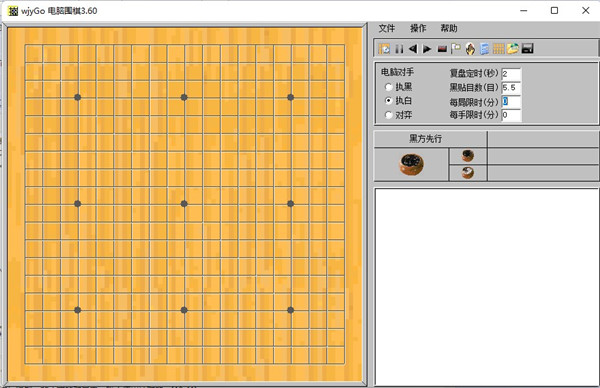
Go game introduction
Go is played using a rectangular grid board and black and white circular chess pieces. There are 19 vertical and horizontal line segments on the regular chess board, and 361 intersection points. The chess pieces must move at the intersections of the blank non-forbidden points. The two sides alternately move and cannot move or regret after placing the pieces. The one with the most lines wins. Because Black has the advantage of first move, it is artificially stipulated that Black should give White a look at the end of the game.
Go game features
1. Can read and save sgf format chess records.
2. You can set the time to automatically demonstrate a single move of the chess record.
3. Supports human-computer chess and player chess play, and automatically saves chess records.
4. Supports functions such as regret chess, winning or losing calculation, timing, etc.
5. Friendly interface.
6. Intelligent Go rule settings, intelligent prompts whether the point can be moved, if it does not enter, do not abandon the move, and prompts for robbery, etc.
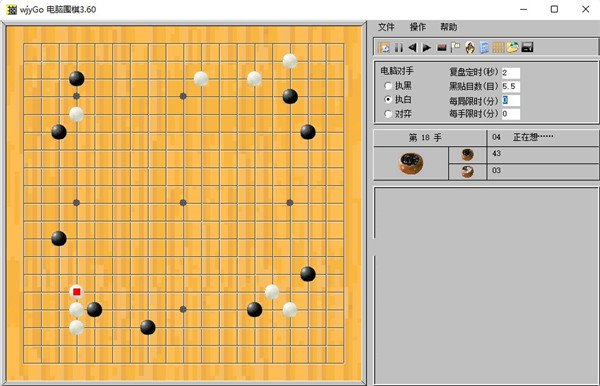
Introduction to Go equipment
1. Chess piece
The chess pieces are divided into black and white. Mostly oblate. The appropriate number of chess pieces is 180 black and white pieces each. The chess pieces are round. China generally uses chess pieces with one side flat and one side convex, while Japan often uses chess pieces with two convex sides. "Yunzi" produced in Yunnan, China, has been favored by players throughout the history and has a history of more than 500 years. The more precious chess piece materials include agate, shell, etc.
2. Chessboard
There are nineteen equally spaced and vertically intersecting parallel lines on the board, forming a total of 19 × 19 = 361 intersection points (hereinafter referred to as "points"). There are nine small dots marked on the disk, called star positions, and the star position in the center is also called "Tian Yuan". When playing handicap chess, the given son must be placed on the star. The chessboard can be divided into "corners", "sides" and "center". In enlightenment learning, there are 13×13 and 9×9 chessboards. In addition, some of the modern unearthed cultural relics are rare 15×15 and 17×17 chessboards.
3. Chess clock
Also called a timer, a timer can be used to limit players’ time in formal competitions. Timers are generally not used in informal games.
4. Chess records
Refers to a tool for recording chess games, usually in the form of a notebook.
Go game play
1. Chessboard and chess pieces
The chessboard has nineteen equidistant and vertically intersecting parallel lines vertically and horizontally, forming a total of 361 intersections. There are nine small dots marked on the disk, which are called star positions. The star position in the center is also called "Tian Yuan". The chess pieces are divided into black and white. The shape is oblate.
2. Ending
The chess game is over when both parties agree that the moves have been completed, or when one party admits defeat midway. The party whose turn it is to lose proposes the ending and then gives up. If the other party does not agree to the end of the game, the other party should be allowed to make a move. The side that gives up the hand immediately regains the right to make the move, and the game starts again until both parties agree on the end.
Both parties have confirmed the final outcome. If there are still points of dispute on the board, their ownership will be handled according to the dual-active method. Both parties must agree on the confirmation of dead chess and live chess. If there is a dispute, the game will be restarted, with the party thought to be dead going first and settled by actual combat.
3. Calculate the outcome
After both parties confirm the final result, they begin to calculate the outcome. Take the Chinese rule number method as an example. Clear the dead pieces of both sides out of the board, count the live pieces of either side and the points surrounded by the live pieces in pieces, and each side gets half of the empty spots between the live pieces. The one with more pieces wins, that is, the one with more than half of the board (180.5) wins. In order to balance the advantage of black moving first, it is stipulated that black has 3 and 3/4 pieces, so black needs 185 pieces to win, and vice versa, white wins.
4. How to play Go
黑先白后,交替落一子于棋盘的点上。 There are no regrets when you make a move, and the chess pieces will no longer move to other points after being placed.
5. Online chess etiquette
At the beginning and after the game, both parties should greet each other to show respect.
If the outcome of the chess game has been decided, or there are no points on the board that will affect the final result. We should take the initiative to propose the final outcome and calculate the outcome, and should not continue to delay and waste the time of both parties.
When playing chess, there should be no words or actions such as attacking or disturbing chess players.
胜固欣然、败亦可喜,局后双方应复盘研究,切磋棋艺,增进友谊。 The winning side must not be complacent, and the losing side should not walk away.
When watching live broadcasts or expert games, you should not attack or insult the players or commentators.
Go update log
1. Fixed BUG, the new version has a better experience
2. Some pages have been changed
Huajun editor recommends:
A very good chess and card game. The editor also uses this software. It is powerful, green and safe. This site also providesChinese chess,Winlinez(Color linez),Yicheng Go,MultiGo Go score software,chessWaiting for you to download.












Useful
Useful
Useful